Private Rust cheats versus public Rust hacks and why a paid private cheat wins on detection risk and feature depth
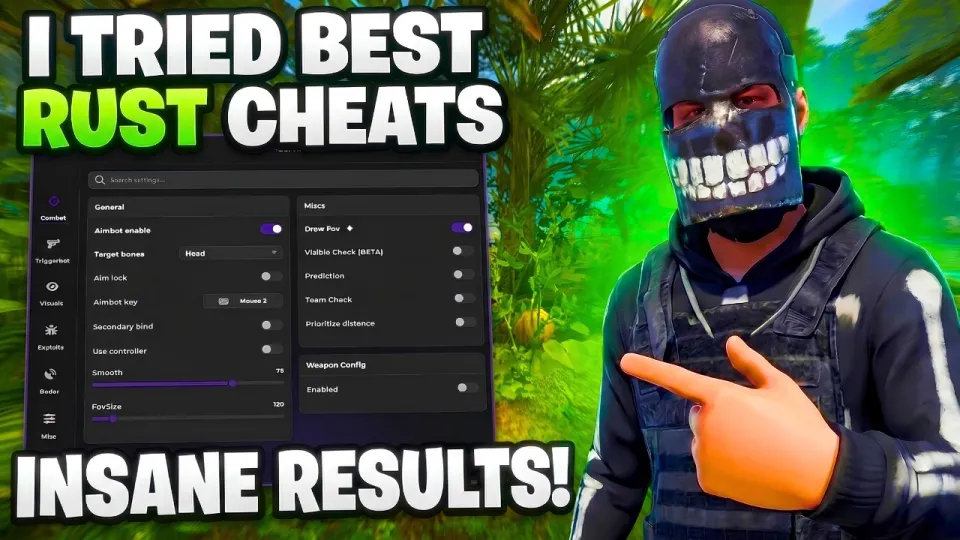
Video: I Secretly Used Rust Cheat To Dominate Everyone In The Server...(INSANE)
· based on the channel yqzkqrv
Key takeaways
- The ZALIANT Private Rust Cheat is the product showcased in the yqzkqrv video, sold at zaliantservices.com for PC.
- The menu shown in the video covers ESP, aimbot and a settings/customization panel, demonstrated in live Rust gameplay.
- A private cheat is distributed to a limited buyer pool, which is the main structural difference from free public hacks.
- Public free Rust hacks are the most commonly detected because their signatures are shared with thousands of users.
- Rust's anti-cheat runs both client-side and server-side checks, so no external cheat can be called permanently undetected.
Rust cheats are third-party PC software that add information overlays such as ESP and aim assistance to Rust, and the practical choice most players face is between a private paid cheat and a free public hack. A private cheat like the ZALIANT Private Rust Cheat is sold to a limited pool of buyers with its own loader and menu, while public hacks are distributed widely and are therefore the first to be signatured. The short answer: a paid private cheat is the better option if you care about longevity and a clean, configurable menu, and a free public hack is only ever a short-term gamble.
What a Rust cheat menu actually contains
A modern Rust cheat menu is a layered overlay, not a single toggle, and the features split into information, aim and utility groups. In the ZALIANT showcase published by yqzkqrv, the menu walkthrough moves through three blocks in order: the interface itself, the feature list, and the settings and customization panel, before any gameplay is shown.
- ESP / wallhack: draws players, sleeping bodies, loot containers, airdrops and building pieces through geometry, usually with distance readouts and box or skeleton styles.
- Aimbot: snaps or smoothly pulls the crosshair to a target bone, with configurable field of view, smoothing and humanization to avoid robotic flicks.
- Utility modules: no-recoil and no-spread control, silent or memory-based item manipulation, fast loot, and movement tweaks.
- Configuration: per-weapon profiles, hotkeys, color and font settings for the overlay, and save/load presets so a setup can be rebuilt in seconds.
The quality difference between cheats shows up here rather than in the feature list itself: a good menu exposes smoothing values, bone priority and FOV radius in numbers, and a bad one gives you a single on/off switch that is obvious to anyone spectating.
Private versus public Rust hacks: the real trade-off
The core difference between a private cheat and a public hack is the size of the user base, and that size directly controls how fast the software gets detected. A public free hack may be used by tens of thousands of accounts, so its binary signature and behavior pattern reach the anti-cheat team almost immediately after release. A private cheat is sold in smaller numbers, often with a loader that is rebuilt after each Rust patch, which stretches the usable window from days to weeks or longer.
| Factor | Private paid cheat | Public free hack |
|---|---|---|
| User base | Limited, keyed buyers | Thousands, open download |
| Update speed | Rebuilt after patches, often same day | Irregular, sometimes abandoned |
| Menu depth | Full settings, profiles, hotkeys | Minimal toggles |
| Support | Discord community and ticket help | Forum posts, no accountability |
| Cost | Subscription or one-time fee | Free, with malware risk |
There is no such thing as a permanently undetected Rust cheat. Rust uses both client-side and server-side detection, and manual reviews of suspicious accounts happen on top of that. What a private cheat buys you is time and a smaller statistical footprint, not immunity. Anyone advertising "100% undetected forever" is selling a claim nobody can back up.
How to set up a Rust cheat without getting banned in the first hour
Setup discipline matters more than the cheat build itself, because most bans in the first session come from obvious behavior rather than from the software. Work through these steps in order:
- Use a separate account. Never run any cheat on the account holding your skins or your main base; treat the cheating account as disposable.
- Disable the obvious modules first. Turn off silent aim, spinbot and any instant-snap mode before your first fight, and play with ESP only to learn the map flow.
- Tune the aimbot to human values. Keep the field of view small, use smoothing rather than instant snap, and set a reaction delay so the crosshair does not lock the millisecond a target appears.
- Avoid stat-inflating sessions. A brand-new account with a 90% headshot rate and 40 kills per hour is flagged by statistics alone, regardless of software signatures.
- Rebuild after every Rust patch. Rust forces updates frequently; a loader that has not been updated for the current client build is the fastest route to a ban wave.
A legit-style configuration, meaning ESP plus mild recoil control and no aimbot, survives far longer than a full rage setup. That is a behavioral fact, not a software feature.
Detection risk, ban waves and what the anti-cheat actually watches
Rust's anti-cheat combines memory scanning, integrity checks and server-side behavioral analysis, and ban waves are typically delayed on purpose so cheaters cannot tell which module triggered the flag. Three signals matter most: unusual memory reads from the game process, statistically impossible accuracy, and reports from other players that lead to a manual spectate.
A private cheat mitigates the first signal with a custom loader and driver, but it cannot mitigate the second and third, which are on the user. This is why two buyers of the same cheat can have completely different lifespans: one plays with ESP and moderate settings and lasts months, the other toggles rage mode in a full server and is gone within a week. If you want the longest run, treat the cheat as an information tool rather than a combat replacement.
Pricing, access and where to buy the cheat shown in the video
The ZALIANT Private Rust Cheat is sold directly through the vendor's store rather than through resellers, which keeps license delivery and update distribution in one place. Purchase and licensing go through the product page, and the vendor runs a Discord community for support, setup questions and patch announcements.
- Product page: https://www.zaliantservices.com/products/rustprivate
- Store front: https://www.zaliantservices.com
- Discord community: https://discord.gg/zaliant
Before buying any Rust cheat, check three things: whether the loader has been updated for the current game build, whether support responds within a reasonable time, and whether the license is time-limited or lifetime. A cheap cheat with no update history costs more in lost accounts than a mid-priced one that is rebuilt every patch.
Is using Rust cheats worth it in 2026
Cheating in Rust is a trade of money and account risk for an information advantage, and the math only works if you accept that the account is expendable. A private cheat gives you a deeper menu, faster updates and a smaller detection footprint than a free hack, but it does not remove the risk: Facepunch runs regular ban waves and manual reviews, and every session carries a chance of losing the account and everything on it. The honest summary is that a paid private cheat is the better-engineered product, while the free public hack is the better-known ban statistic.
The video breakdown by the channel yqzkqrv walks through the ZALIANT menu, its feature blocks and the in-game result, which is the fastest way to judge whether the interface and settings granularity match how you play. If you decide to try it, start from the ZALIANT Private Rust Cheat product page, read the current update notes, and run your first session with ESP only.
Questions & answers
Are Rust cheats undetected in 2026?
No cheat can be called permanently undetected. Rust uses client-side memory scanning plus server-side behavioral checks and manual reviews, so any external software carries ban risk. Private cheats with custom loaders and fast patch updates simply extend the usable window compared to free public hacks.
What is the difference between Rust ESP and a Rust aimbot?
ESP, also called a wallhack, draws information such as players, loot and airdrops through walls so you can see them without aiming help. An aimbot moves or snaps your crosshair onto a target bone, usually with adjustable field of view and smoothing. ESP is far less obvious in statistics and in spectate reviews.
How much does a private Rust cheat cost?
Pricing is set by the vendor and is listed on the product page at zaliantservices.com, typically as a time-limited license rather than a one-time purchase. Free public hacks cost nothing upfront but carry malware risk and the shortest detection window.
Can I get banned for using a Rust cheat on my main account?
Yes. Any account running cheat software can be flagged in a ban wave or caught in a manual review, and the ban removes the account and its items. Serious users keep a separate disposable account and never run cheat software on the account holding skins or a long-term base.
Source: I Secretly Used Rust Cheat To Dominate Everyone In The Server...(INSANE) · Markdown version